
In this article
Understanding Rioja today means going beyond grape varieties and traditional ageing categories. In 2017, Rioja introduced a new geographical classification system designed to identify and communicate the origin of the grapes more precisely. Within this framework, which also includes zonal and village wines, Viñedo Singular represents the highest level of terroir expression in Rioja. Alongside Rioja’s classic oak-aged classification system, this structure offers a complementary way of understanding origin and style in the region, as explored in the article “Understanding Rioja wine classifications”.
Viñedo Singular refers to officially recognised single vineyard sites with exceptional characteristics, strict production requirements and full Rioja traceability from vine to bottle. The wines produced from these vineyards must also meet additional requirements, including a specific tasting approval. As a result, this represents one of the clearest expressions of terroir-driven wines in Rioja, highlighting place, precision and quality.
Why Rioja created the Viñedo Singular category
Origin and purpose
The category was created to recognise and protect vineyards with unique natural conditions and a proven history of producing exceptional wines. Many of these sites are very old-vine plots, shaped by distinctive soils or specific microclimates that justify individual recognition. This approach supports a more sustainable viticulture model by preserving historic sites that have long adapted to their environment and form part of the region’s viticultural heritage. At the same time, it strengthens Rioja’s quality hierarchy and offers consumers greater transparency and a clearer understanding of the region’s geography and vineyard identity.
A shift toward terroir and site identity
The global wine world increasingly values site-specific wines, authenticity and origin transparency. Viñedo Singular aligns Rioja with this movement. The designation highlights terroir as a central part of Rioja's identity, complementing iconic styles like Crianza, Reserva and Gran Reserva with a framework focused on vineyard expression.
This shift echoes themes already explored in “The three zones of Rioja: Alta, Alavesa and Oriental”, where geography and climate shape wine character.
What makes a vineyard “Singular”
Old vines and low yields
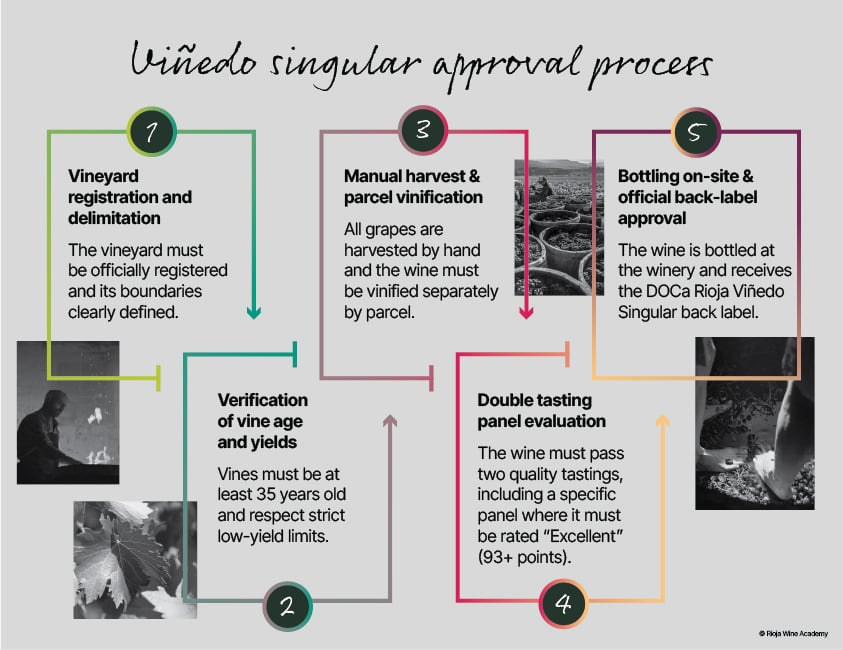
For a vineyard to qualify, it must be at least 35 years old, allowing well-developped root systems, better adapted to the individual site, and allowing it to express its terroir with greater precision. Each site must also show distinctive characteristics that are clearly reflected in the wine.
Yields are significantly lower than standard Rioja limits, reinforcing concentration and quality, two key markers of old-vine Rioja. Maximum authorised yields are set at 5,000 kg/ha for red varieties (equivalent to 32.5 hl/ha) and 6,922 kg/ha for white varieties (45 hl/ha).
Producers or growers may apply for Viñedo Singular recognition if they have been working the vineyard for at least the previous 10 years. The application requires submitting a detailed dossier to the Control Board demonstrating compliance with all regulatory requirements. Once approved, the vineyard is added to the official register of recognised Viñedo Singular sites. To date, 164 vineyards have received this designation.
Manual harvest and parcel-based winemaking
All grapes must be harvested manually, and the vineyard must be vinified separately. This reinforces true parcel-based Rioja winemaking, preserving the vineyard’s identity from the moment the grapes are picked until they are bottled. In addition, transformation yields for Viñedo Singular wines are lower than for other Rioja categories, limiting the grape-to-juice ratio to a maximum of 65 litres per 100 kg of grapes. This further reinforces quality and concentration in the winemaking process.
Double tasting panel and strict approval
Every Viñedo Singular wine must pass two quality evaluations. The first evaluation follows the same procedure as for other Rioja wines, while the second is conducted by a specific tasting panel, where the wine must achieve a minimum median score of 93 points to be rated as “Excellent.” This process ensures that each finished wine meets the highest standards under Rioja wine regulations, providing a clear guarantee of quality and reliability for the customer.
Single Vineyard vs. Viñedo Singular
Stricter requirements and traceability
While many producers worldwide use “single vineyard” on labels, Viñedo Singular is a legally protected term. It comes with defined geographic boundaries, mandatory vineyard registration and full traceability at every stage, with rigorous quality checks built into the process to ensure that only wines of the very highest standard can carry the designation. This level of oversight goes far beyond typical single-vineyard claims.
Authenticity and legal protection
The designation ensures that only wines genuinely tied to a specific vineyard can use its name on the label. This protects both producers and consumers, guaranteeing authenticity and origin.
For further context on Rioja’s regulatory structure, see “Understanding Rioja wine styles”.
How to identify a Viñedo Singular wine
The back label
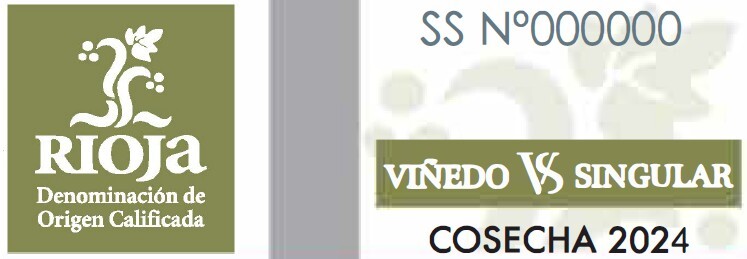
Besides the compulsory mention of “Viñedo Singular” on the front label, each certified bottle carries a distinctive back label from the DOCa Rioja. This seal allows consumers to instantly recognise wines that come from a registered, officially recognised Viñedo Singular.
What the back-label guarantees
The seal confirms what we have explained above:
- The vineyard’s official registration and approved boundaries.
- Minimum vine age and maximum authorised yields.
- Manual harvesting.
- Separate vinification.
- Successful evaluation by two tasting panels, the second one rated as “Excellent”.
- Strict compliance with Rioja wine regulations.
In other words, it guarantees origin, quality and true vineyard identity.
What to expect in the glass
Precision and site character
Viñedo Singular wines often show remarkable clarity, purity and expression of place. Their aromas and textures reflect grape varieties, soil composition, altitude, aspect, microclimate and farming decisions. Elements explored in “What impacts the taste of Rioja wine?”.
Diverse styles but always limited volume
Because the vineyards are small and yields are intentionally low, production is limited. Styles vary, from mineral, tense whites to structured, age-worthy reds, but all wines share a sense of precision and connection to their site.
Why Viñedo Singular matters today
Terroir transparency
The category responds to a growing desire among wine drinkers for Rioja terroir wines that clearly communicate where they come from. Viñedo Singular makes terroir more visible and understandable, from the vineyard to the bottle.
Value and recognition for top vineyard sites
For growers, the designation acknowledges decades of careful farming and rewards outstanding plots with the recognition they deserve. It also helps preserve heritage vineyards that are essential to Rioja’s future. For wineries, both small and large, it offers greater visibility for their project and a way to strengthen their positioning in the premium segment.
Learn more about Rioja’s terroir at Rioja Wine Academy
Understanding Viñedo Singular is key to understanding Rioja’s present and future.
If you want to deepen your knowledge of Rioja geography and classifications, the Rioja Wine Academy offers comprehensive learning resources. We recommend starting with the Rioja Enthusiast course and continuing with the Rioja Wine Diploma for a more complete understanding.


Post A Comment
See Comments