
In this article
Rioja is more than a name, it’s a guarantee. Behind every bottle certified as DOCa Rioja stands a rigorous system of quality control, managed by the Rioja Control Board (Consejo Regulador), initiated over 100 years ago. Today, across moe than 100 km, Rioja brings together a remarkable diversity of zones, grapes and winemaking styles. This diversity is held together by a strict regulatory framework, from vineyard registration and yield limits to ageing classifications and geographic origin labelling, ensuring full traceability from vineyard to bottle.
The creation of Rioja’s Denominación de Origen in 1925 is widely considered a collective achievement. It emerged from the shared need of Rioja’s growers and winemakers to protect their wines from falsification, a growing problem fueled by the region’s increasing prestige. The preamble of the Royal Decree of October 22, 1926, explicitly recognised this first major victory: the official protection of Rioja as a unique wine region.It was this same Royal Decree that formally created the Consejo Regulador, the control body responsible for supervising grape growing and wine production, ensuring authenticity and issuing the first guarantee seals. Rioja’s more than two millennia of winemaking heritage played a decisive role in the establishment of Spain’s first-ever Denominación de Origen.
Since then, the Control Board has worked to protect Rioja’s identity and quality, ensuring that every wine bearing its seal reflects excellence, authenticity and a deep respect for provenance and tradition.
What is the Rioja Wine Control Board?
The institution behind Spain’s first DOCa
Besides protecting and promoting the name of Rioja, the Rioja Control Board is the governing body that oversees all production, labeling, and quality standards within the Rioja Qualified Designation of Origin, in order to guarantee its origin. Rioja became Spain’s first recognized Denominación de Origen in 1925 and, in 1991, the first region to receive the prestigious “Calificada” (DOCa) status, a recognition granted only to regions with exceptional and consistent quality under the strictest regulatory controls.
How the Control Board preserves authenticity, quality, and reputation
The Control Board acts as both guardian and innovator. It defines the production area, authorises grape varieties, sets yield limits and regulates winemaking and ageing techniques. Every vineyard, grape and bottle is controlled and certified to ensure full traceability.
While the Control Board safeguards Rioja’s historic identity, it also supports innovation: new styles, new categories, and terroir-driven wines. In fact, Rioja has always been a pioneer: it was the first protected Spanish wine region, the first to classify wines according to their ageing regime, the first to require bottling at origin, and one of the first Spanish regions to introduce more terroir-focussed labeling options. This balance between heritage and evolution is central to Rioja’s philosophy: protecting what makes Rioja great while showing the world that there is much more beyond the classic image.
Rigour and excellence remain at the core of everything the DOCa represents.
History and mission of the Consejo Regulador
From 1925 to today: more than a century of regulation and excellence
From 1925, when the name Rioja was officially protected, the foundations were laid for what would become one of the world’s most respected wine regions. The following year, in 1926, the first Control Board was established, marking the beginning of a structured system designed to safeguard authenticity, protect both producers and consumers from fraud, and uphold quality standards. From the outset, this pioneering spirit set Rioja apart.
Over the decades, the Consejo Regulador has evolved in step with the region itself, responding to advances in technology, shifting market expectations, and changing consumer demands, while remaining firmly committed to its core principles of integrity and transparency. Rioja has consistently been at the forefront of innovation within Spain: in 1980, it became the first Spanish appellation to regulate and guarantee ageing designations such as Crianza, Reserva, and Gran Reserva, reinforcing consumer trust and clarity in the marketplace.
In 1991, Rioja further cemented its leadership by becoming Spain’s first Qualified Designation of Origin (Denominación de Origen Calificada or DOCa), the country’s highest classification for wine regions, in recognition of its consistent quality and rigorous control systems.
This forward-looking approach has continued into the 21st century. In 2007, new grape varieties were approved, reflecting both tradition and adaptability. More recently, in 2017, Rioja introduced a more detailed system of geographic indications (including zonal, village, and single-vineyard wines), allowing for greater expression of terroir and origin. The appellation has also expanded its scope with the recognition of sparkling wines, further demonstrating its commitment to innovation while preserving its historic identity.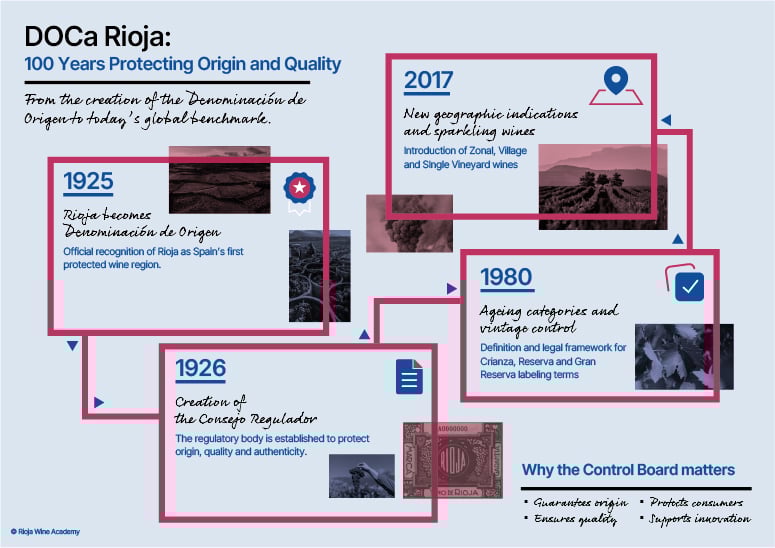
The mission: to safeguard Rioja’s identity through transparency and innovation
Today, the Control Board’s mission is twofold: to protect Rioja’s identity, provenance and quality through clear rules and transparency, and to promote the region and its wines on a global stage. While this article focuses mainly on the first role, the second is equally essential: giving visibility to Rioja, reinforcing its reputation and supporting the commercial success of its wines. At the same time, the Control Board ensures that the regulatory framework evolves with the times, allowing innovation while preserving what makes Rioja distinctive. It serves as a meeting point of the main stakeholders of the region, coordinating the work of hundreds of wineries and thousands of growers, and acting as a bridge between tradition, sustainability and innovation.
How the Rioja Control Board ensures Quality
Strict vineyard registration and grape control
Only grapes grown within the officially delimited Rioja area can be used to make DOCa Rioja wines. All vineyards must be registered and monitored, ensuring that yields never exceed the maximum authorised by regulation. Each registered grower holds an official grape growers card, which identifies their vineyards and varieties and allows every harvest to be traced from the plot to the winery, reinforcing transparency and full traceability throughout the system.
Production limits and traceability from harvest to bottle
Each stage, from grape harvest to bottling, is tightly controlled to ensure that every bottle can be traced back to its vineyard of origin. Maximum yields are clearly defined to protect quality: 6,500 kg per hectare for red varieties and 9,000 kg per hectare for white varieties, limits that are reviewed annually. In 2025, the Control Board went a step further by introducing village-specific yield limits, reinforcing quality and better reflecting the reality of local growing conditions.
Traceability is further guaranteed through strict transformation yields, which limit production to 72 litres of wine per 100 kg of grapes, preventing over-extraction and dilution. In addition, wineries authorised to produce DOCa Rioja wines must be exclusively dedicated to Rioja, meaning no other wines can be produced within the same facility. All ageing and bottling must also take place within the Rioja area, ensuring full control, transparency and integrity from vineyard to bottle.
Tasting panels and certification before market release
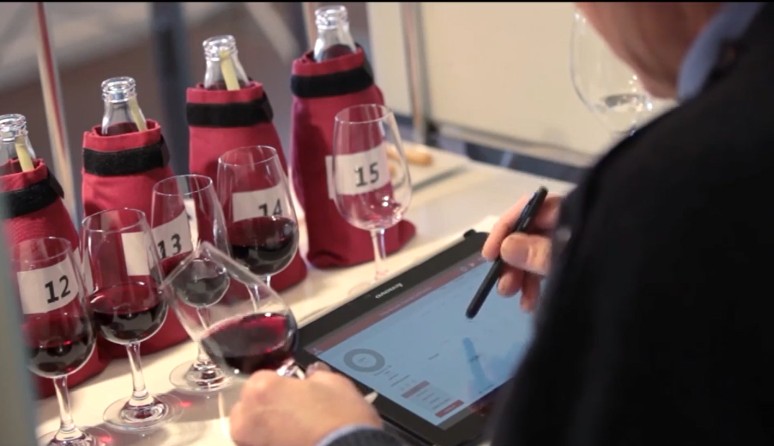
Before a wine can be released to the market as DOCa Rioja, it must pass both analytical and organoleptic tests. These sensory evaluations are carried out by tasting panels made up of around 130 trained professionals, who collectively assess more than 5,000 wine samples each year. Their role is to verify that each wine meets Rioja’s strict sensory and chemical standards, confirming quality, typicity and consistency before it reaches the market.
The Rioja quality pyramid: understanding DOCa classification
Zona, Pueblo, Viñedo Singular: new levels of geographical identity
Beyond its traditional ageing categories, Rioja now also officially classifies wines by their geographic origin. Consumers can identify wines from a Zone (Zona) such as Rioja Alta, Rioja Alavesa, or Rioja Oriental; from a Village (Vino de Pueblo), or from a Single Vineyard (Viñedo Singular), the highest level of precision, recognising unique plots with exceptional characteristics. Wines labelled as Viñedo Singular must also pass a dedicated tasting panel and achieve an “outstanding” score of 93 points or more, reinforcing their status as the top expression of origin and quality.
For more on these designations, explore the article “Understanding Rioja Wine Classifications.”
These origin-based classifications highlight the region’s commitment to terroir, transparency and diversity, a central pillar of Rioja’s contemporary approach to positioning itself and communicating the identity of its wines.
From Generic to Gran Reserva: age classification and barrel requirements
Rioja’s other classification system is based on ageing time. Wines may be labeled as Generic, Crianza, Reserva, or Gran Reserva, depending on the duration spent in oak barrels and bottle before release. This hierarchy, also strictly controlled by the Control Board, ensures that the style and maturity of each wine are clear and reliable for the consumer.
How to identify official Rioja wines
The color-coded back labels issued by the Control Board
Every certified bottle carries an official back label (backstamp) issued by the Consejo Regulador. These labels are color-coded: green for generic wines, red for Crianza, burgundy for Reserva, and blue for Gran Reserva, as explained in the article “How to read a Rioja label: joven, crianza, reserva and gran reserva”.
Decoding the information on a Rioja bottle
Besides the back label, each bottle includes information such as the producer, the vintage, the category, and sometimes the geographical indication (Zona, Pueblo, or Viñedo Singular). These elements help consumers understand the wine’s origin and style at a glance.
For a detailed guide, visit our article “How to Read a Rioja Label.”
How certification protects consumers from imitation
The certification seal not only guarantees authenticity but also protects consumers from imitation and misuse of the Rioja name. All DOCa Rioja wines must be bottled and labelled at origin, ensuring that control is maintained until the final stage. Each back label features a tamper-proof hologram and is individually numbered, allowing total traceability and giving consumers trust in the authenticity and integrity of every bottle they purchase.
Innovation and sustainability initiatives
Research and innovation plays a key role in the continuous evolution of the Rioja Control Board, incorporating new tools into its system of control. From satellite monitoring to vineyard mapping and precision data tools, these technologies enhance traceability and support more efficient vineyard management across the appellation, particularly in the face of a global warming. This work helps strengthen the region’s capacity to adapt to increasing climatic variability while helping it remain viable for future generations, without compromising its quality or identity.
Why the Rioja Control Board matters to consumers
The Control Board’s work means that when you purchase a bottle of Rioja, you are choosing a wine backed by nearly a century of regulation and more than two millennia of winemaking heritage. Every certified bottle, regardless of price or classification, guarantees its origin and compliance with clearly defined quality standards, offering consumers a solid foundation of trust and reliability. When you buy and drink a Rioja, you are relying on a system built on quality, transparency and respect for the land.
This combination of heritage, rigour and diversity has positioned Rioja among Spain’s finest and one of the most respected wine regions in the world.
Learn more about the Rioja Control Board on Rioja Wine Academy
If you want to understand how DOCa Rioja’s regulations, certifications, and classifications protect and elevate the region’s wines, explore our courses at Rioja Wine Academy.
Start with the Rioja Enthusiast course for a comprehensive introduction, or take the Rioja Wine Diploma for an in-depth journey through the region’s history, geography, and quality systems.
Post A Comment
See Comments