
In this article
Most people know Rioja for its red wines. However, its history is also marked by great white wines, from the traditional long-aged wines to the fresher and more aromatic styles that today triumph in Spain and abroad. In recent decades, the region has undergone a true revolution: new authorised white grape varieties, new winemaking techniques and a renewed focus on Viura and terroir have completely transformed Rioja whites.
This article traces this evolution and explains how Rioja has gone from a classic style to a diversity of profiles ranging from young fruity wines to ageing whites and terroir-focussed wines.
Origin of white wine in Rioja
The historical role of Viura
For decades, Viura has been the dominant white variety in Rioja. Its good natural acidity and its ageing capacity made it the variety of choice for the classic style of Rioja whites, characterised by long ageing in barrel and bottle.
At a time when stability, longevity and ageing complexity were sought after, Viura fulfilled all the conditions. Its aromatic neutrality allowed prolonged ageing to provide layers of dried fruit, honey and smoky notes.
The classic whites and their traditional style
Historically, long barrel-aged white wines have been one of Rioja’s defining hallmarks. Made mainly from Viura and small proportions of other varieties such as Malvasía, they shaped a style that is profound, complex, and capable of remarkable ageing.
Far from disappearing, they remain an essential part of Rioja’s identity today and are considered some of the region’s most distinctive and highly regarded white wines, both in Spain and internationally.
The transformation of Rioja white wine
New varieties and new consumers
The great turning point came in 2007, when Control Board allowed new white varieties, including Tempranillo Blanco, Maturana Blanca, Turruntés, Verdejo, Chardonnay and Sauvignon Blanc.
As detailed in the article "Rioja varieties you should know", this varietal diversification has greatly expanded the aromatic and stylistic range.
At the same time, modern consumers have begun to demand fresher and more expressive wines, which has led to a profound renewal of Rioja whites.
Evolution of techniques and styles
The advances in viticulture and winemaking have brought more precise harvests, better controlled fermentations, and a more delicate extraction, together with an increasingly precise and subtle use of barrels, working with lees, the incorporation of alternative ageing vessels, such as concrete or foudres, and a growing focus on the expression of origin.
All this has allowed Rioja white wines to evolve towards an enormous diversity of profiles and styles.
White varieties authorised in Rioja
Viura: structural basis
Viura firmly remains the backbone of Rioja whites. Its acidity, its ageing capacity and its versatility allow to produce wines ranging from young wines to Reservas and Gran Reservas. It is also key in many quality sparkling wines, as we explain in "Sparkling Rioja: Discover the new face of Rioja wines".
Tempranillo Blanco: freshness and aromatics
Discovered in 1988, it represents one of the most important transformations in Rioja’s white wines. It brings aromatic intensity, citric and tropical notes, and a freshness that has caught the attention of new consumers.
Garnacha Blanca and Malvasía
Garnacha Blanca adds volume and texture, along with a Mediterranean character and subtle spicy notes, while Malvasía Riojana adds floral notes and richness, being key in white wines destined for ageing.
Maturana Blanca and other varieties
Maturana Blanca offers an Atlantic profile with high acidity, nerve, and a marked aromatic identity.
Other authorised varieties, such as Chardonnay, Sauvignon Blanc or Verdejo, are usually used in blends that seek greater aromatic expression or tension.
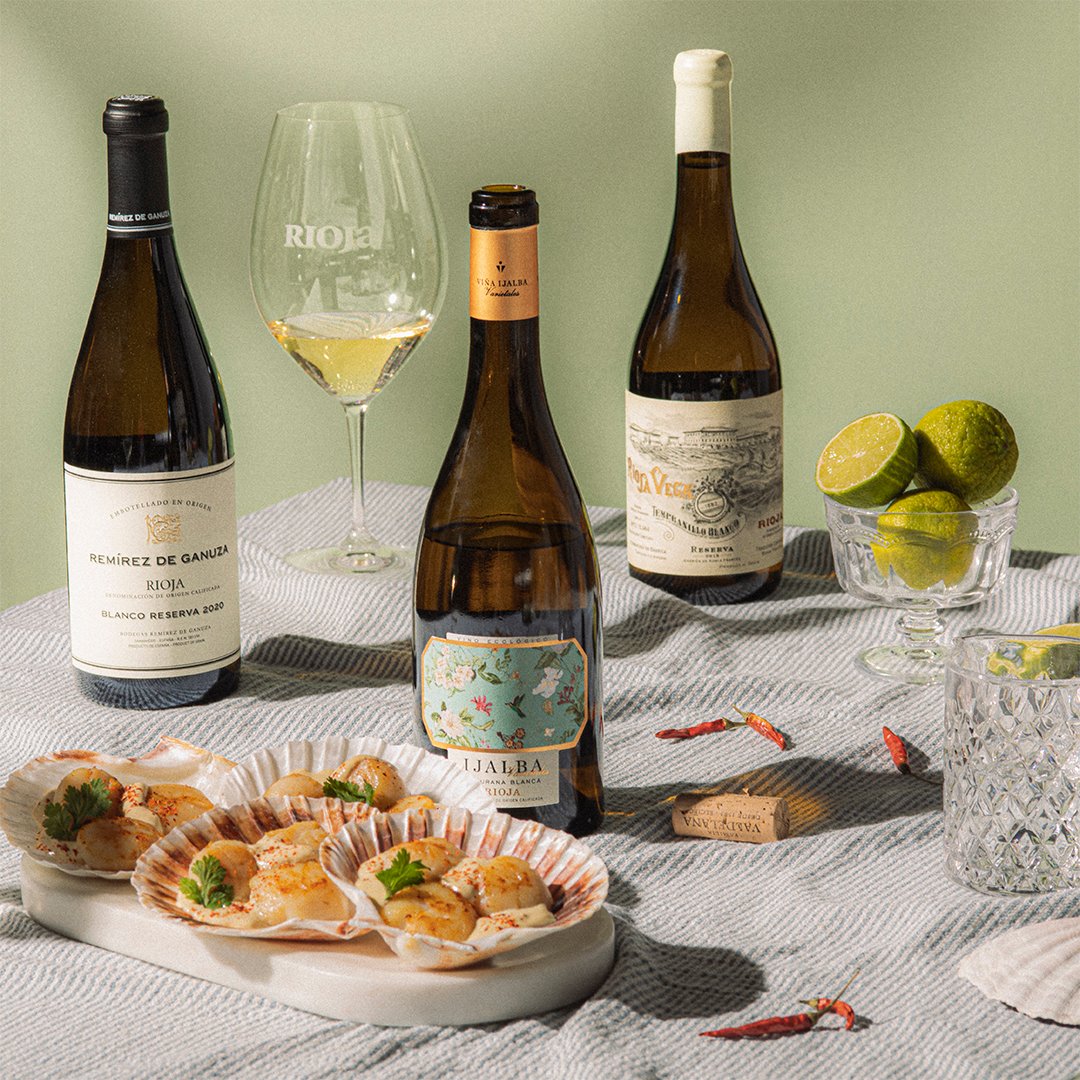
Different styles of white wine in Rioja
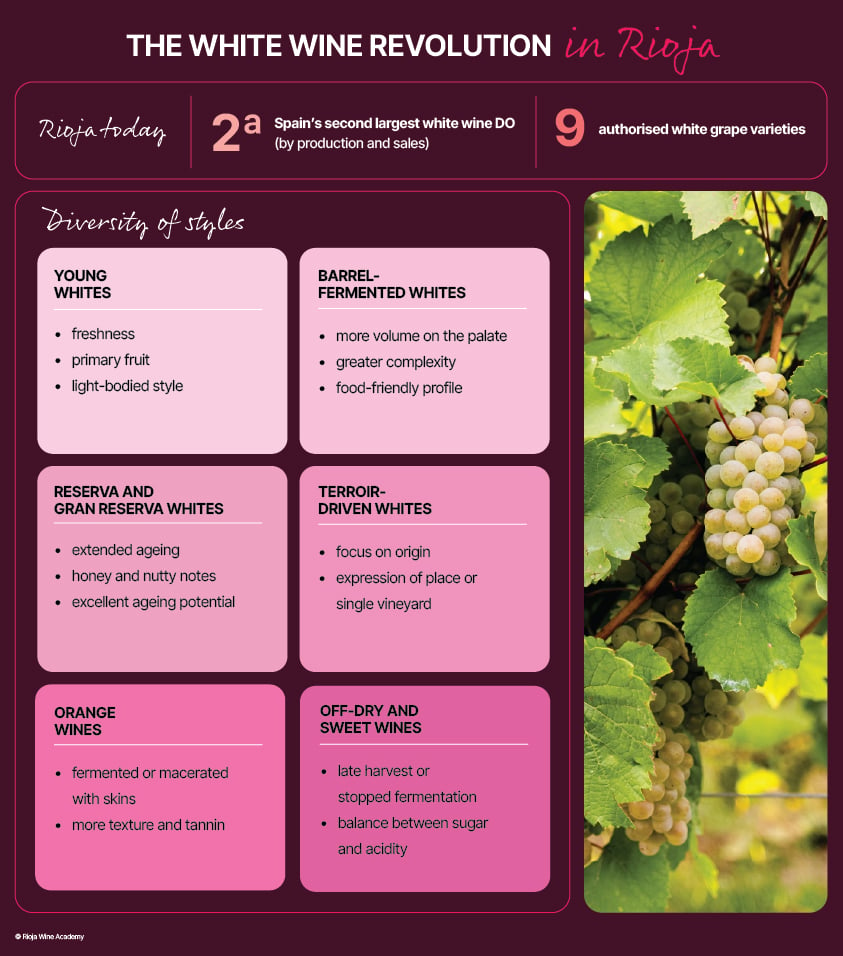
Young and fruit-forward whites
Made in stainless steel and fermented at low temperatures, these wines seek immediacy, freshness and a direct expression of the fruit. They are pure, youthful styles, designed to be enjoyed at a young age, where aromatic purity and a refreshing sensation on the palate take centre stage. They are usually made with varieties such as Tempranillo Blanco, Viura or Garnacha Blanca, with occasional aromatic contributions of Verdejo or Sauvignon Blanc.
Barrel fermented
Alcoholic fermentation in barrels adds volume, texture and complexity without seeking oxidation. They are gastronomic wines, with a very precise balance between fruit and wood, where the barrel acts as a refining tool rather than a protagonist. Traditionally, Viura has been one of the most widely used varieties in this style due to its good affinity with oak and its ability to maintain freshness and structure during fermentation and ageing. If you would like to learn more about how oak influences wine, you can read the article "The barrel in Rioja: tradition and innovation".
Reserva and Grand Reserva whites
Based mainly on Viura, sometimes complemented with Malvasía Riojana or Garnacha Blanca, these wines are aged for long periods of time, giving rise to aromas of dried fruits, honey, spices and hints of evolution. They are deep, complex and age-worthy whites, and represent some of the most unique white wines in Spain.
To better understand how these categories work and what they imply in terms of ageing, you can consult the article "Understanding the classifications of Rioja wines".
Terroir-based whites
Here, the focus is on the origin. In this style, wines are sought that accurately reflect the area, the village or even the plot where their grapes are grown. To achieve this, winemakers use a variety of techniques and vessels, from concrete tanks to large foudres or used barrels, always with the aim of not masking the fruit and terroir.
In Rioja, the varieties that are said to best capture this expression of place tend to be Viura, because of its acidity and aromatic neutrality, which allow the soil and climate to come through clearly, and Garnacha Blanca, especially in more Mediterranean areas, where it provides volume and a character closely linked to the place. Maturana Blanca also plays an increasing role in terroir-based wines, to which it contributes its natural tension.
To learn more about how the profiles change depending on the area, you can check "The three zones of Rioja: Alta, Alavesa and Oriental".
Orange wines
Orange wines are made from white grapes that are fermented with their skins, similar to red wines. This maceration provides colour, tannin and a more marked texture, as well as aromatic notes reminiscent of orange peel, candied fruit, tea, dried herbs and flowers.
In Rioja, production remains limited, but these wines form part of the region’s growing stylistic diversity and are found in wines made by producers exploring traditional or minimal-intervention techniques.
In Rioja, orange wines are usually made mainly with Viura, the most abundant white variety, because of its natural balance and ability to develop complexity during maceration. Garnacha Blanca and Malvasía Riojana are also used, which provide greater volume and a more expressive aromatic profile. Other authorised varieties, such as Tempranillo Blanco or Maturana Blanca, appear in smaller productions that explore alternative styles.
Semi-sweet and sweet wines
These are made with traditional sweet winemaking techniques, through interrupted fermentations or with late-harvested grapes. Their production is a minority, but they are part of the historical heritage of the region.
In Rioja, the white varieties most commonly used for this type of wines are Viura and Malvasía Riojana, for their natural balance between acidity and structure, and for their ability to preserve freshness even with higher sugar concentration. Garnacha Blanca provides volume and honeyed notes in riper wines, while Tempranillo Blanco can offer intense aromatic profiles in semi-sweet versions.wine
Although not the most common styles, especially outside Spain, these wines reveal another facet of the potential and diversity of Rioja white wines.
The impact of Tempranillo Blanco
A mutation that changed Rioja
Tempranillo Blanco was discovered in 1988 in Murillo del Río Leza (Rioja Oriental) as a color mutation of red Tempranillo. This spontaneous variation of the vine gave rise to a white-skinned grape from the original red variety. This discovery was a unique opportunity for Rioja. Aromatic, vibrant and highly adaptable, Tempranillo Blanco has made it possible to create modern, expressive whites, in line with the styles demanded by today's consumers.
Its influence on the new whites
It is the variety that best meets current demand: freshness, intense aromas and versatility. Today, it is the second most planted white variety in Rioja, and its presence has been key in the renewal of the style of fruit-driven white wines in the area, but as the vineyards get older and knowledge of the variety increases, its potential for ageing in oak is also being discovered.
Tradition and innovation in today's whites
Today, the historic aged white wines coexist with new styles focused on the terroir, increasingly precise barrel fermentations, more careful management of old vineyards and growing experimentation in small plots. This combination has significantly broadened Rioja's stylistic landscape.
"Understanding Rioja wine classifications" delves into the rise of local, village and single vineyard wines. All of this is driving whites that more clearly express their origin and the identity of the landscape from which they come.
What to expect from Rioja white wines today
Diversity of styles and profiles
The white revolution has created a range that goes from young wines to long-ageing whites, transforming Rioja into the second most important white wine appellation in Spain in terms of production and marketing. Today, Rioja is recognised as an outstanding reference in the Spanish white wine scene, offering styles capable of satisfying all tastes.
More gastronomic and global presence
The freshness, elegance and complexity of Rioja whites have consolidated them as authentic references in fine dining restaurants and in the main international markets. Although they do not always seek the aromatic exuberance of other whites, they stand out for their extraordinary texture, their refinement and an unmistakable gastronomic character that places them among the great white wines of the world.
Learn more about Rioja whites at Rioja Wine Academy
If you want to learn more about varieties, styles, terroir and winemaking techniques, we recommend the Rioja Enthusiast course and the Rioja Wine Diploma, where you can discover first-hand how the wines that are transforming Rioja are made.
Post A Comment
See Comments